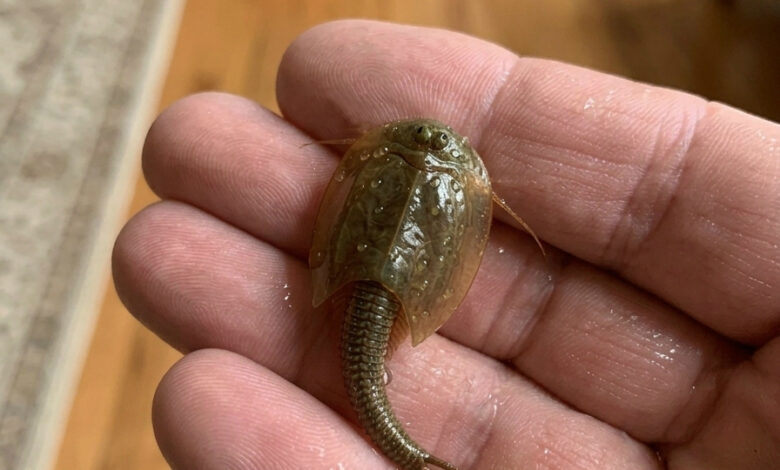
The storm had been relentless, a torrential downpour that turned the mundane neighborhood streets into a network of rushing rivulets and overflowing gutters. When the clouds finally parted, leaving behind the heavy, petrichor-scented air of a humid afternoon, the world felt transformed. It was in this post-storm stillness that I found myself wandering near the edge of my property, where a deep drainage ditch had become a temporary river. The water was murky, swirling with silt and debris, but something caught my eye—a frantic, rhythmic movement just beneath the surface of a stagnant pool left behind by the receding floodwaters.
At first glance, my heart hammered against my ribs with a primitive, instinctive fear. The creature was alien, a twitching, olive-brown shape that looked like it belonged in a medical textbook under a chapter on invasive parasites or deep-sea nightmares. It had a broad, shield-like carapace and a long, segmented tail that lashed through the water with surprising agility. Without thinking, driven by a mixture of morbid curiosity and the urge to identify a potential threat, I grabbed a glass jar from the garage. With a swift, shaky motion, I scooped the creature out of the silt.
However, as the search results began to populate, the narrative of horror I had constructed in my mind started to crumble. The creature in my jar was not a parasite. It wasn’t a monster, and it certainly wasn’t a threat. It was a Triops—a member of a genus of small crustaceans that are frequently referred to by biologists and paleontologists as “living fossils.” As I read further, the initial revulsion I felt was replaced by a staggering sense of perspective. The tiny, frantic being swimming circles in my kitchen was part of a lineage that stretches back nearly 300 million years.
To put that into context, the ancestors of this Triops were swimming in puddles and shallow pools during the Carboniferous and Permian periods, long before the first dinosaur ever thundered across the prehistoric plains. While the mighty Tyrannosaurus rex rose to dominance and eventually vanished into the fossil record, the humble Triops remained virtually unchanged. It has survived the Great Dying—the Permian-Triassic extinction event that wiped out 96% of marine species—as well as the asteroid that ended the age of the giants. It has witnessed the drift of continents, the rising and falling of mountain ranges, and the birth of the human race, all while maintaining its ancient, effective design.
The realization was profound. The creature I had plucked from a muddy, forgotten ditch was a direct descendant of a biological success story so robust that it made the entirety of human history look like a mere footnote. My kitchen, once just a room of appliances and modern conveniences, suddenly felt like a temporary waypoint for a traveler from deep time.
The secret to their incredible survival lies in a biological marvel known as diapause. Triops are specialists in ephemeral environments—puddles, ditches, and seasonal ponds that exist for only a few weeks before evaporating under the sun. To survive in such a volatile world, they produce “resting eggs” or cysts. These eggs are nearly indestructible, capable of lying dormant in parched, sun-baked soil for decades. They can withstand freezing temperatures, extreme heat, and the crushing weight of the earth. They wait with a patience that defies human understanding, suspended in a state of biological stasis, until the right conditions return.
A single heavy storm, like the one I had just witnessed, is the cosmic alarm clock for these prehistoric sleepers. When the rain fills a forgotten depression in the ground, the dormant eggs rehydrate. Within hours, the ancient blueprints are activated, and the Triops hatch, growing at an explosive rate to ensure they can reproduce before their temporary home disappears once again. We walk past these puddles every day, complaining about the mud on our shoes or the humidity in the air, completely unaware that beneath our feet, a prehistoric resurrection is taking place.
I looked at the Triops again, but the lens of my perception had shifted. I no longer saw a “creature” or a “bug.” I saw a fragile, exquisite relic of the Earth’s distant past. I saw the incredible resilience of life, the way it clings to the margins and finds a way to persist through cataclysms that level entire ecosystems. The lashing of its tail was no longer creepy; it was a rhythmic pulse of a history that refuses to die.
The quiet awe that settled over me was humbling. We often look to the stars or deep into the ocean to find wonders, imagining that anything truly extraordinary must be far away or hidden in the shadows. But here was a miracle of evolution, a survivor of the ages, found in a common drainage ditch in a suburban neighborhood. It was a reminder that the past is never truly gone; it surfaces in the smallest corners of our everyday world, waiting for a bit of rain and a curious eye to be recognized.
Later that evening, I walked back out to the ditch. The water was starting to soak into the ground, and the temporary pool was already shrinking. I carefully tilted the jar, watching as the Triops slid back into the murky water. It immediately began to dig into the silt, perhaps preparing to lay the next generation of eggs that would sleep through the coming years of drought. As I watched it disappear into the shadows of the muddy bank, I felt a deep sense of gratitude. I had started the day afraid of a parasite, only to end it in the company of a legend. The world felt larger, older, and infinitely more mysterious than it had just hours before. The living fossil was back in its element, a tiny sentinel of deep time, continuing a journey that began before the world as we know it even existed.
