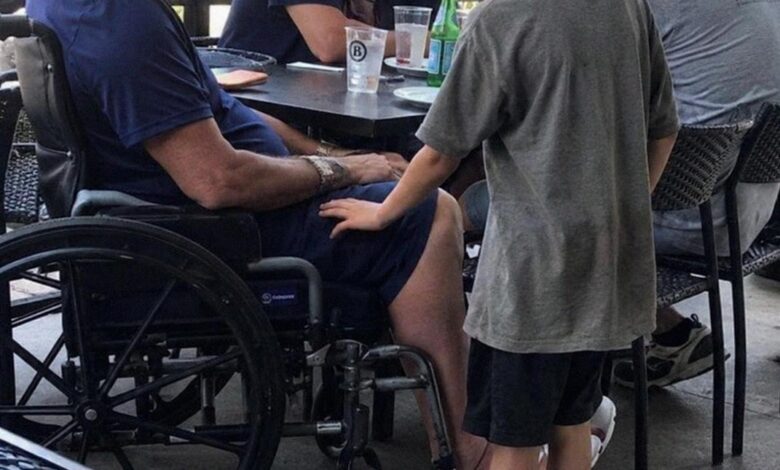
I spent twenty years paralyzed, trapped in a wheelchair by a devastating accident, only to have a grimy, ten year old stranger walk up to my café table and promise to make me walk again. I laughed in his face, dismissing it as the ramblings of a child—until my toes, dead for two decades, suddenly flickered. In that terrifying, electric moment, the veneer of my entire existence shattered. A stranger approached with a folder that contained the truth I never dared to imagine: the physician I trusted more than anyone had been lying to me for years, and he had stolen my life for his own selfish gain.
For two decades, the memory of that day at the lake had served as my personal prison. I was a man who had everything—a thriving career, a beautiful wife, and a future that stretched out like an endless horizon. Then came the dive, the hidden rock, the sickening snap of my neck, and the sudden, permanent silence of my legs. Since that day, Dr. Voss had been my shadow. He was more than a doctor; he was a fixture at my dinner table, a comfort at my family funerals, and the architect of my resignation. He had spent twenty years telling me that my injury was absolute, irreversible, and final. I had believed him because I had no reason not to.
The café was supposed to be a place of business, a sanctuary where I could focus on contracts instead of my own atrophy. When the boy, Eli, stood by my chair, his eyes fixed on my motionless foot with the detached precision of a surgeon, I felt an inexplicable shiver. When he said, “I can fix your legs,” the table erupted in laughter. It was a cruel, necessary release of tension. But then he began to count. When he reached three, the impossible happened. My foot shifted. My toes curled. The air left the room, leaving behind a silence so profound I could hear the heartbeat of the man sitting across from me.
Sarah, the woman who appeared from the shadows behind me, held the key to my cage. She was the little girl I had pulled from under that dock twenty years ago, a life I had saved while losing my own. She had grown into a brilliant rehabilitation physician, and through a twist of fate, she had stumbled upon my records. She didn’t just find a mistake; she found a cover-up. She laid the folder on the marble table, revealing scans that showed clear, undeniable signs of nerve regeneration that had been occurring for nearly a decade. Voss hadn’t just missed it; he had actively hidden it.
The betrayal was so immense it felt physical. I went to Voss’s clinic, my hands shaking against the rims of my wheels. He played the part of the concerned professional perfectly, dismissing Sarah as an opportunist and laughing off the “miracle” as a coincidence. He was so confident in his status, so wrapped in the armor of his own reputation, that he couldn’t imagine I would actually challenge him. He underestimated my need for the truth. I left his office not with closure, but with a burning, cold determination to unmask the man who had traded my mobility for his own academic vanity.
I sought a second opinion at a facility where my name meant nothing and my history was just data. The independent radiologist, a woman who looked at my spine with clinical indifference, stopped midway through the review. She looked at me with a mixture of pity and outrage. She confirmed that my nerves had been healing on their own for at least eight to ten years. A decade of recovery had been buried under Voss’s ego. He had published papers on the “irreversibility” of injuries like mine, building a career on the false premise that I would never stand again. To admit I was healing would have been to admit his life’s work was a lie.
The confrontation in his office was the final act. When I walked back in, accompanied by Sarah and the irrefutable evidence of my own returning strength, the mask finally slipped. Voss didn’t look like a healer; he looked like a cornered animal. He snapped, he ranted, and he exposed the rot of his own ambition. He wasn’t protecting me from false hope; he was protecting his bank account and his precious credibility. Watching him lose his temper was more therapeutic than any physical therapy I had ever endured. I didn’t need to scream; his own fury was enough to destroy him.
Reporting him to the medical board felt less like a chore and more like an exorcism. When his license was suspended, the news rippled through the community, and other patients began to speak out. The “hero doctor” was revealed to be a charlatan, and I was finally free from the invisible tether he had wrapped around my potential. But the battle was far from over. My muscles had atrophied, my spirit had been tested, and my body had forgotten how to bear the weight of the world. The journey back to walking wasn’t a magic trick; it was a grueling, painful, and beautiful process of rediscovery.
Months later, I stood in my garden, surrounded by the scent of blooming roses and the watchful eyes of my wife and Sarah. The parallel bars Claire had installed stood as a testament to the fact that while a decade had been stolen, the future was still mine to claim. Eli, the boy who had changed the trajectory of my life with three simple numbers, stood by like a pint sized trainer, waiting for the signal. He counted to three, and for the first time in twenty years, I let go of the bars.
My first step was clumsy, shaking, and uncertain, but it was mine. My second step was stronger. With every movement, I was reclaiming the space in the world that Voss had told me I would never occupy again. I looked up at Sarah, then at Claire, whose hands were pressed tightly over her mouth to stifle her sobs. I wasn’t just walking across a garden; I was walking out of a prison. I had survived the lake, I had survived the chair, and I had survived the doctor who tried to keep me in the dark. I took another step, and then another, toward the rest of my life, finally standing on my own two feet.
