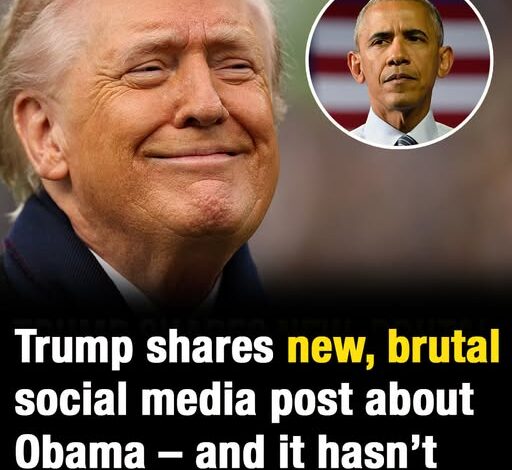
The current climate of political communication has undergone a radical transformation, moving away from the hallowed halls of traditional diplomacy and into the volatile, high-speed arena of social media. At the epicenter of this seismic shift is Donald Trump, a figure who has redefined the boundaries of public discourse through a calculated blend of digital showmanship and strategic provocation. His recent activity involving a brutal post directed at former President Barack Obama is not merely a random act of online venting; it is a masterclass in a new form of political theater where tone, symbolism, and the ability to incite a reaction are valued far above the nuances of policy or institutional decorum.
The post in question features a meme that taps into a decade-long narrative of rivalry between the two presidents. It specifically references the skepticism that defined the early days of Trump’s political ascent, back when the established elite viewed his ambitions as little more than a punchline. While Barack Obama did famously express public doubt regarding Trump’s path to the White House during the 2016 cycle, the meme takes those historical moments and distills them into a sharp, exaggerated visual punch. This is the inherent power of the political meme: it functions as a form of historical compression, taking complex, multi-layered events and shrinking them into a single, emotionally charged image that can be consumed and shared in seconds. It is a tool designed for the thumb-scroll era, where the goal is to stop the viewer in their tracks and evoke an immediate, visceral response.
To understand the impact of such a post, one must look past the surface-level text and analyze the underlying intent. This is a strategy of vindication. By resurfacing Obama’s past doubts, Trump reinforces a personal rivalry that his base finds deeply compelling. For his supporters, these posts are not seen as immature or unnecessary; they are viewed as a badge of authenticity and a triumphant reminder of a leader who proved the “experts” and the establishment wrong. It frames his entire political career as a narrative of the underdog who shattered the status quo, turning the mockery of his predecessors into a weapon of modern influence. To his audience, this kind of content is symbolic of a confidence that refuses to bow to conventional norms, a digital “I told you so” that resonates more deeply than any white paper or policy speech ever could.
Conversely, for his critics, these moments represent a troubling departure from the dignity typically associated with the office of the presidency. From this perspective, the use of unconventional imagery, AI-generated content, and direct jabs at high-profile figures—including the recent and controversial mentions of Pope Leo XIV—is interpreted as a descent into spectacle. The concern among these observers is that the lines between serious governance and entertainment are being blurred to the point of erasure. They argue that when the primary mode of communication is designed for virality and emotional engagement, the substantive issues facing the nation are pushed to the periphery. This creates an environment of perpetual polarization, where the medium itself becomes a barrier to common ground.
This shift reflects a broader evolution in how the world’s most powerful figures connect with the public. In previous generations, presidential communication was a study in restraint. Every word was weighed for its diplomatic implications, and every image was carefully curated to project stability and formality. However, modern digital platforms do not reward restraint; they reward immediacy and the ability to dominate the news cycle through sheer force of personality. Trump has mastered this reward system, understanding that a provocative post can generate more organic reach and media coverage in an hour than a traditional press release could in a week. It is a lean, aggressive style of communication that bypasses traditional media gatekeepers and speaks directly to the emotions of the electorate.
The significance of these posts extends far beyond the specific jabs at Barack Obama. They act as a catalyst for a specific kind of public discourse that prioritizes personality and rivalry over the dry details of legislation. This is not accidental. By keeping the national conversation focused on a cycle of action and reaction, a political figure can maintain a constant state of relevance. Every time a “brutal” post is shared, it forces both supporters and critics to engage with the figure behind it. Supporters rush to defend the humor and directness, while critics rush to condemn the tone, and in the middle of this digital tug-of-war, the figure at the center remains the undisputed protagonist of the national narrative.
Furthermore, the rise of AI-generated imagery and the willingness to direct messaging at unexpected targets, such as religious figures or international icons, suggests that the boundaries of this new communication style are still expanding. There is no longer a “forbidden” zone in digital campaigning. If a post can spark a conversation or trend on a global scale, it is considered a successful piece of content by those who manage these digital empires. This reflects a reality where the spectacle is the message, and the reaction is the goal. Whether this is a positive development for democracy or a dangerous erosion of institutional guardrails is a question that defines the current era.
Ultimately, the impact of these social media maneuvers depends entirely on the lens through which they are viewed. To some, it is the democratization of political speech—a way for a leader to communicate with the people without the filter of an often-hostile press. To others, it is the fragmentation of the public square, where the loud and the provocative drown out the thoughtful and the measured. What remains undeniable is that the era of the “quiet” presidency is over. In its place is a landscape of high-definition rivalries, silver-bucket karma, and digital volleys that ensure that no matter what the topic of the day might be, the focus never shifts away from the personalities who have learned to turn the internet into their most powerful political weapon. As we move further into 2026, these tactics will only become more sophisticated, leaving the public to navigate a world where the truth is often painted in the vibrant, clashing colors of the latest viral meme.
