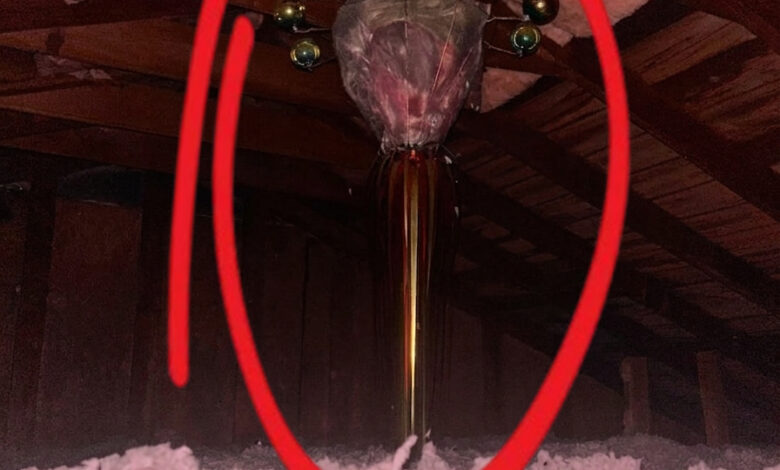
Attics have a unique and often unsettling way of making the familiar feel completely alien. They are the silent repositories of our pasts, filled with the low light of forgotten memories, thick layers of dust, and years of untouched storage that can distort even the most mundane everyday objects into shapes that appear strange or even terrifying at first glance. When you are crawling through the rafters and stumble across something unusual tucked into a dark corner or buried deep beneath a stack of rotting boxes, it is only natural for the imagination to take over. In the quiet gloom of the upper crawlspace, the brain attempts to make sense of the unknown, often leaping to the most dramatic or frightening conclusions possible. However, history and experience suggest that a closer, calmer, and more methodical look almost always reveals a reality that is far less mysterious but infinitely more fascinating.
The first step when encountering a bizarre find in the heights of your home is usually to pause and observe rather than reacting with immediate panic. Objects that appear confusing or even threatening from a distance often contain small, highly recognizable details when they are examined with a steady hand and a clear mind. You might see the texture of a specific material, the precise curve of a manufactured edge, or a faded pattern that provides a vital hint as to what the object once was in its former life. What initially feels like an alarming discovery—perhaps something that looks like an ancient relic or a sinister stowaway—can often be identified once you adjust your perspective, bring in a stronger light source, and take the necessary time to study the item properly.
In many situations, the perceived strangeness of an attic find comes simply from the twin forces of age and environment. Over time, stored items undergo a slow and silent metamorphosis. The extreme fluctuations in temperature and humidity found in an attic can cause wood to warp, plastic to fade or become brittle, and fabric to gather dust until it resembles something organic or skeletal. A forgotten holiday decoration, a broken component from a long-discarded appliance, or even a disassembled piece of antique furniture can change so much in its physical appearance that its original purpose becomes entirely unrecognizable to the modern eye. Without the proper context of the era in which it was used, these physical changes can easily lead to a profound misunderstanding of the object’s intent.
The key to mastering the mysteries of your own home is to approach such discoveries with a sense of clinical curiosity rather than wild assumption. Clarity is found by looking from different angles, checking for familiar mechanical components like screws or hinges, and considering how decades of storage conditions may have chemically or physically altered the item. In the vast majority of cases, what seems like a supernatural mystery or a hidden secret is simply something ordinary that has been weathered and transformed by the relentless passage of time, waiting patiently in the dark to be recognized once again.
Beyond the physical decay, there is also the psychological element of the attic itself. These spaces are often associated with the subconscious, representing the things we have hidden away or forgotten. When we enter an attic, we are already in a state of heightened awareness, our senses tuned to the creaks of the floorboards and the shadows cast by the eaves. This mental state makes us prone to pareidolia, the human tendency to see significant patterns or faces where none exist. A tangle of old electrical wires can look like a nest of snakes; a dress form covered in a dusty sheet can easily be mistaken for a silent figure standing in the corner. Understanding that our brains are hardwired to find threats in the darkness is the first line of defense against jumping to the wrong conclusion.
If you find something that truly defies your initial attempts at identification, the modern world offers tools that our ancestors never had. Digital research and community forums dedicated to identifying obscure objects have turned many an attic nightmare into a lesson in industrial history. Many strange finds turn out to be specialized tools from a bygone era—items like cobbler’s lasts, victorian hair receivers, or early twentieth-century kitchen gadgets that have long since been replaced by modern technology. These objects aren’t scary; they are the physical fingerprints of the people who lived in your home before you, offering a tangible connection to the history of the structure.
Furthermore, the process of identifying these strange finds can be a deeply rewarding experience. It turns a moment of fear into a journey of discovery. When you finally realize that the “strange creature” in the corner is actually a water-damaged pile of vintage furs or that the “unexplained machinery” is an early prototype for a vacuum cleaner, the relief is accompanied by a sense of triumph. You have mastered the environment and demystified the unknown. You have proven that the shadows only hold power when they are left unexamined.
Ultimately, the hidden things in your attic serve as a reminder that the world is full of layers. Our homes are not just the spaces we occupy today; they are archives of every season that came before. Every strange object, every warped board, and every dusty box has a story to tell, provided we are brave enough to look closely. The next time you find yourself staring at something unrecognizable in the dark, remember that clarity is only a flashlight beam away. Take a breath, move closer, and look for the truth beneath the dust. You will likely find that the only thing hiding in your attic is a bit of history that was waiting for the right person to come along and remember its name. By choosing curiosity over fear, you transform your home from a place of potential mysteries into a sanctuary of understood history, ensuring that your peace of mind remains intact no matter what you find behind the insulation.
