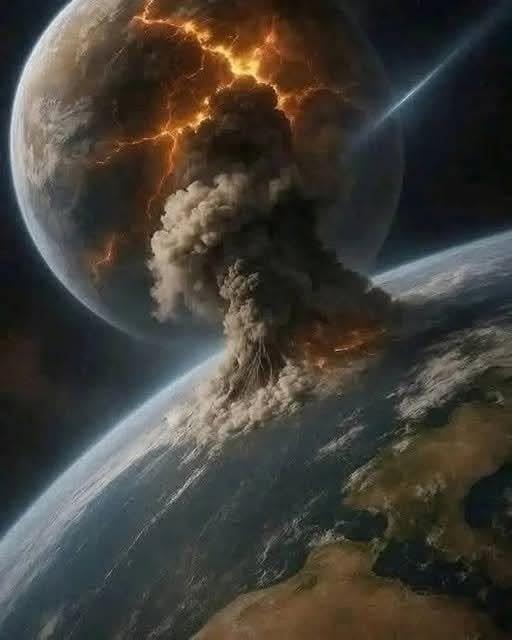
The warning appeared quietly, wrapped in technical language and steady reassurances. At first, it sounded routine—just another cosmic visitor passing through our neighborhood, one of thousands that astronomers track every year. But as more details emerged, the tone began to shift. Size estimates slipped into the conversation, and suddenly this wasn’t just another passing rock. It was something far larger—something capable, at least in theory, of changing the course of life on Earth.
The object is known as 52768 (1998 OR2), a cold, numerical designation that does little to convey its scale. Estimated to measure between 1.5 and 4 kilometers across, it belongs to a rare and potentially devastating class of near-Earth objects. Asteroids of this size are not merely local threats; they are global ones. If an object of this magnitude were ever to strike Earth, the consequences would extend far beyond the immediate impact zone—triggering atmospheric disturbances, widespread fires, and long-term climate effects that could reshape ecosystems across the planet.
To put it into perspective, objects significantly smaller than this have already demonstrated the destructive potential of cosmic impacts. The Chicxulub impact event, widely believed to have contributed to the extinction of the dinosaurs, involved an asteroid estimated at around 10 kilometers in diameter. While 52768 (1998 OR2) is smaller, it still falls within a category capable of causing continental or even global-scale disruption.
Fortunately, agencies like NASA and its Center for Near Earth Object Studies are dedicated to tracking such objects with remarkable precision. Using a network of ground-based telescopes and advanced computational models, scientists continuously monitor the asteroid’s orbit, velocity, and trajectory. At approximately 8.7 kilometers per second, it moves at a staggering speed, yet its path has been calculated with enough accuracy to reassure experts.
According to current projections, the asteroid is expected to pass safely by Earth’s orbit on June 2nd, maintaining a distance that poses no real threat. Scientists have repeatedly emphasized that there is no impact trajectory, no immediate danger, and no reason for public alarm. In astronomical terms, this is considered a “close approach,” but in practical terms, it remains well within safe limits.
And yet, despite these reassurances, the asteroid’s presence raises a deeper and more unsettling question—one that goes beyond this single object.
Humanity’s ability to defend itself against cosmic hazards is still in its early stages. While detection systems have improved dramatically over the past few decades, they are not perfect. Smaller objects can still go unnoticed until they are dangerously close, and even larger ones may only be detected with limited time for response. The challenge is not just seeing what’s out there, but seeing it early enough to act.
Efforts are underway to address this vulnerability. Missions like DART mission have begun testing potential strategies for planetary defense. By intentionally colliding a spacecraft with an asteroid, scientists aim to learn how to alter its trajectory—a concept that could one day prevent a catastrophic impact. Early results have shown promise, but scaling such efforts to handle larger objects remains a significant challenge.
Beyond technology, there is also the issue of coordination. A global threat requires a global response, yet international cooperation can be complex. Decisions about how to respond to a potential impact—when to act, how to act, and who takes responsibility—would need to be made quickly and collectively. In a crisis measured in days or weeks, delays caused by political or logistical factors could prove critical.
Funding is another factor. Planetary defense does not always rank high among immediate global priorities, often competing with more visible or urgent concerns. Yet the risk, while low in probability, carries consequences so severe that even a small chance demands attention.
This is why events like the approach of 52768 (1998 OR2) matter. Not because they pose an immediate danger, but because they serve as reminders—brief moments when the abstract becomes tangible. They force us to confront the reality that Earth exists within a dynamic and sometimes unpredictable cosmic environment.
For now, the calculations remain in our favor. The asteroid will pass at a safe distance, its trajectory confirmed by multiple independent observations. Scientists will continue to track it, refining their models and ensuring that any future changes are detected early.
But the broader story is not about this particular asteroid.
It is about preparedness.
It is about the thin margin of safety that separates us from potential catastrophe—a margin maintained not by luck alone, but by vigilance, science, and continued investment in understanding the space around us.
The question that lingers is not whether 52768 (1998 OR2) will hit Earth. It won’t.
The real question is whether we are ready for the one that might.
Because somewhere in the vastness of space, countless objects continue their silent journeys. Most will pass unnoticed. Some will come closer. And one day, perhaps, one may come too close.
When that moment arrives, the outcome will depend not on chance, but on how well we prepared when we still had time.
